Showing posts with label Other Israel Film Festival. Show all posts

Thursday, November 10, 2022

Other Israel Film Festival Spotlight: Lady Amar

I’m delighted to be returning for the eighth time to cover the Other Israel Film Festival, which features a diverse crop of thought-provoking and often difficult, complex, Israeli and Palestinian cinema and is hosted by the JCC Manhattan. The 16th Annual Other Israel Film Festival runs virtually and in-person November 3rd-10th, 2022.

Lady Amar
Directed by Yigael Sachs and Noam Gil
Ticket Information

The loss of mental capacity typically comes at a point that it’s no longer possible to recognize that change for the person in question. They may believe that they are lucid and aware of what is happening around them, yet the way in which they communicate their perception of reality indicates that’s not the case. Memory loss and confusion can often set in and lead to someone mistaking others for figures from their past and, at times, believing themselves to be someone else. “Lady Amar” explores one woman’s disassociation from her identity and how that affects her three adult children.

A woman (Orly Tabaly) is picked up off the street at night and brought into a house. She insists to her apparent abductors that she is Pauline Weiss, a high-powered woman who does not belong in a place like this and should be freed immediately. Those around her attempt to persuade her that they are her children: Israel (Itzik Golan), Yarden (Liz Rabian), and Levanon (Victor Sabag), and all she needs to do to remember them is to take her medicine. She appreciates that they think she is their mother but continues to repeat what she believes is the truth, that she is not the woman that they think she is.

As the sole narrative selection at this year’s Other Israel Film Festival, “Lady Amar” represents a different kind of journey. Pauline, whose children tell her she is Jacqueline Amar, comments multiple times that she has nothing against Moroccan immigrants, as if her position is one that makes her evolved and compassionate. But instead it reveals a buried self-hatred and embarrassment of her own heritage that manifests itself when she takes on a new identity, newly able to comment on how she sees herself since she, in that moment, isn’t Moroccan and enjoys a different kind of existence within Israeli society.

The way in which Jacqueline, as Pauline, talks down to and invalidates her children who are pleading with her to do what they say she most needs is painful to watch, and those who have experienced relatives suffering through dementia and other degenerative diseases will surely find this film even more difficult and honest. It’s amplified by the fact that Pauline appears perfectly healthy and competent, with her affliction affecting only her perception of who she is and not her physical health. Understanding that she is suffering from something else is a rollercoaster process enhanced by strong performances from all four cast members. This portrait of lost identity is stirring and haunting, effectively channeling the often miserable process of degenerative aging.

B+

Wednesday, November 9, 2022

Other Israel Film Festival Spotlight: The Forgotten Ones

I’m delighted to be returning for the eighth time to cover the Other Israel Film Festival, which features a diverse crop of thought-provoking and often difficult, complex, Israeli and Palestinian cinema and is hosted by the JCC Manhattan. The 16th Annual Other Israel Film Festival runs virtually and in-person November 3rd-10th, 2022.

The Forgotten Ones
Directed by Michale Boganim
Ticket Information

It’s dispiriting but sadly not surprising to learn that discrimination is a universal concept that isn’t unique to any one country or situation. The establishment of Israel as a haven for the Jewish people in the aftermath of the Holocaust should have been a welcome call for Jews from all over the world, particularly places in which they still faced persecution, to come to somewhere that would accept them as they are. Yet the experience of Mizrahi Jews coming from North Africa and the Middle East was considerably colder and dominated by a condescending division from their European counterparts.

Filmmaker Michale Boganim looks at her own family as a key instance of this reality, charting her father’s arrival to Israel from Morocco and the treatment he faced. The founding of the Israeli Black Panthers and their perception of a similar situation within the United States at the same moment is central to his legacy, along with the response of the Israeli government to what they saw as an undesirable and potentially dangerous community not worthy of their attention, and certainly not of the respect for which they were advocating.

It’s interesting to see how, in many cases, the Mizrahi Jews who have come from predominantly Arab countries find themselves living peacefully alongside their Arab neighbors since that’s something they were all used to back home. Seeing a common ally, some advocate that Arabic should be taught just like English in school, while others seek to distance themselves from Arabs since they believe that makes them stand out even more, eager instead to be accepted and perceived as just as Jewish or Israeli as those of European descent.

Among the themes explored in this documentary is the idea that there are devoutly religious Mizrahi Jews who are still not seen as equal to those with lighter skin, and the discrimination they experience is often veiled as something less toxic and covered up with excuses. It’s a disturbing and compelling subject that was also dramatized in “The Unorthodox” and is very much worthy of a spotlight, and Boganim strongly surveys the ways in which this has come to permeate and define Israeli society. Tracing this phenomenon from its roots to how it continues to manifest in today’s world is often unpleasant but clearly important and worthwhile. It’s both a specific case study and one that audiences from anywhere should have no trouble finding a way to comprehend and find relatable.

B+

Other Israel Film Festival Spotlight: The Last Chapter of A.B. Yehoshua

I’m delighted to be returning for the eighth time to cover the Other Israel Film Festival, which features a diverse crop of thought-provoking and often difficult, complex, Israeli and Palestinian cinema and is hosted by the JCC Manhattan. The 16th Annual Other Israel Film Festival runs virtually and in-person November 3rd-10th, 2022.

The Last Chapter of A.B. Yehoshua
Directed by Yair Qedar
Ticket Information

It’s always enlightening to watch a film about an author, since the two mediums are inherently different and fans of a writer’s work aren’t necessarily used to seeing the person behind their beloved words as a living and breathing person. In the case of A.B. Yehoshua, an acclaimed Israeli writer who passed away this past June at the age of eighty-five, his cinematic biography provides a wondrous and welcome window into the life of a man who famously didn’t want any identity and enjoyed a remarkably warm relationship with many different communities.

Accomplished filmmaker Yair Qedar has profiled many Israeli authors in the past, and Yehoshua seems perfectly pleased to be his latest - and possibly greatest - subject. Born in 1936 in what was then British Mandatory Palestine, Yehoshua came of age seeing his native-born father enjoy good relations with Arabs as the country of Israel was established. The relationship between his father and his Moroccan immigrant mother is something he returns frequently to as a negative example of old age because they did not love each other, while he is still processing the death of his own wife.

Yehoshua is well aware of his situation and his declining health, commenting that all of his friends are dead and that he feels as if he’s left standing guard with a rifle. Yet that doesn’t stop him from continuing to share his work with eager young minds and prominent leaders. He gets a call from former Israeli President Reuven Rivlin, whom he describes as a good friend, and then is enthusiastically welcomed by a Palestinian group that appreciates his call for a productive solution to the current conflict. He’s a rare figure who is seen as an ally to many people and groups with theoretically incongruent goals, yet he rejects any label or attempt to pigeonhole him into an identity that may be applicable but doesn’t serve him any productive purpose.

This film uses animated backdrops to highlight excerpts from Yehoshua’s books that provide a brief glimpse into the themes he returned to and help his words come alive for those unfamiliar with his work. This buoyant and engaging documentary has added poignancy due to Yehoshua’s death ahead of this screening, framing this as a properly-titled last chapter in which Yehoshua himself has the chance to have the final say on what he thinks of his legacy.

B+

Tuesday, November 8, 2022

Other Israel Film Festival Spotlight: The Samaritans: A Biblical People

I’m delighted to be returning for the eighth time to cover the Other Israel Film Festival, which features a diverse crop of thought-provoking and often difficult, complex, Israeli and Palestinian cinema and is hosted by the JCC Manhattan. The 16th Annual Other Israel Film Festival runs virtually and in-person November 3rd-10th, 2022.


The Samaritans: A Biblical People
Directed by Moshe Alafi
Ticket Information

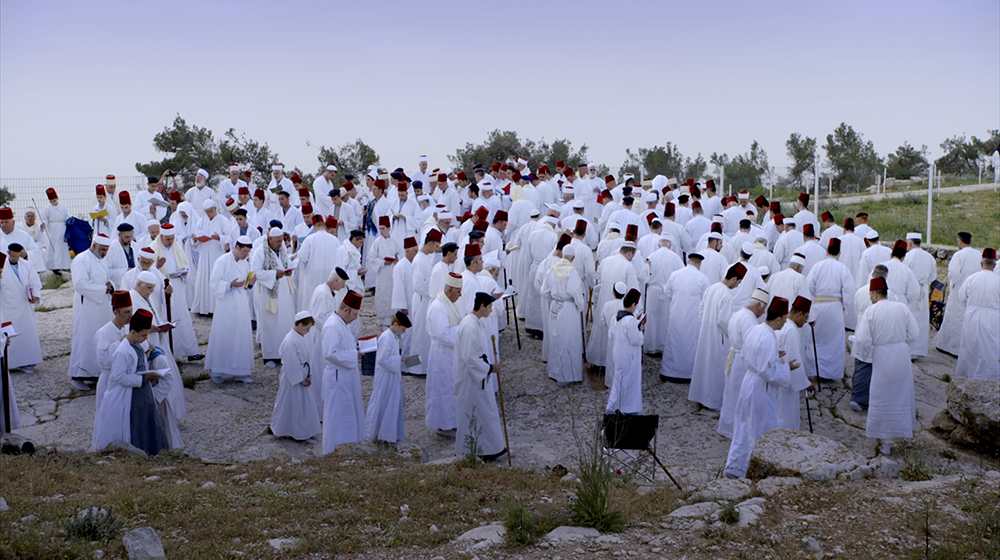
It’s easy to think of Israel as a country containing Jews, Muslims, and Christians, but there are still other religions that lay claim to the historical land as a holy and important one. One of the most fascinating are the Samaritans, who describe themselves not as Israeli or Palestinian, but rather as their own religion of 800-something people, still existing after many years and practicing their own customs deeply rooted in tradition and only partially influenced by tensions with modernity.

Filmmaker Moshe Alafi zeroes in on a number of members of the Samaritan religion, who have their own Torah, their own Shabbat, and their own unique rituals, like a physical Passover sacrifice which has deep meaning for all involved. Prominently featured is the cantor, who plans to have his son take over for him in the future and who has his own ideas for how to keep the religion alive, as well as one man who is traveling to Ukraine, a frequent place for men to find wives who are willing to convert into the religion, which has an insular community that does not otherwise typically turn outward to welcome in new adherents.

It’s remarkably interesting to learn about the aspects of the Samaritan faith that may remind many of their own devout religions, and whose members, particularly those who have chosen to join from Ukraine, seem to know might strike an uneducated viewer as unusual. Among the most startling is a custom of unplugging refrigerators and not using air conditioning on Shabbat, something that those interviewed acknowledged is not universally observed due to the incredible heat that can become unbearable.

The honesty and openness with which the interviewees speak is refreshing, particularly because they are not intending to proselytize or to bring anyone else in to the religion. A plan to convert thousands of eager future followers in Brazil involves a caveat that they will remain separate to learn how to be proper Samaritans and not dilute the original, ever-shrinking sect. There is a pride that all featured share about something they consider fulfilling, and like any religion or culture, there are bound to be pieces that aren’t entirely ideal. This is an informative, invigorating look into a faith that has survived for centuries and faces similar challenges to so many other movements, but clearly benefits from a strong bond from its members to its defining tenets.

B+

Monday, November 7, 2022

Other Israel Film Festival Spotlight: The Devil’s Drivers

I’m delighted to be returning for the eighth time to cover the Other Israel Film Festival, which features a diverse crop of thought-provoking and often difficult, complex, Israeli and Palestinian cinema and is hosted by the JCC Manhattan. The 16th Annual Other Israel Film Festival runs virtually and in-person November 3rd-10th, 2022.

The Devil’s Drivers
Directed by Daniel Carsenty and Mohammed Abugeth
Ticket Information

Borders are a complicated matter, especially in a place where the division between two lands isn’t always clear and is disputed. It’s unlikely that a film about those who smuggle Mexican people into the United States through Texas or Arizona would get made since the two countries are firmly established and those crossing wouldn’t argue that they aren’t breaking the law. But for Palestinians coming into Israel, this subject is apparently something that can be filmed and celebrated, painting its protagonists as soldiers in a fight for free access.

Hamouda and Ismail are Bedouin Palestinians who live in the West Bank along the southern border of Israel, where the boundary wall has yet to be constructed and therefore provides easier access for them to use to their advantage. They know that they must operate in an aggressively attentive and constantly-changing way, since previously safe routes can at any point become untenable and they could be arrested if other drivers opt to cooperate with the Israeli army and turn them in rather than go to prison themselves.

“The Devil’s Drivers” makes the argument, conveyed passionately by its two lead subjects, that they have no choice but to do this work since there is no other way to provide for their families. They express how the Israelis go to great lengths to put roadblocks in their way and take punitive measures to discourage them from remaining involved in smuggling efforts. When one of them is arrested after declining a phone call from two people who subsequently committed a terrorist attack in Israel, they bemoan the unfair treatment that they have received. They do seem aware of the reality - that they evade capture 99.9% of the time but then get punished for everything the one time they do get caught - but still find any sort of consequence unjust because this is their only choice.

Stylistically, this film does enhance its storytelling with animation to chronicle the multiple uprisings by Palestinians that resulted in heightened security and a decrease in permission mobility for Hamouda, Ismail, and their families. They know things might be safer for them if they stopped driving, but they also believe they must continue to have some hope of a fulfilling existence for those they love. Ultimately, this portrait feels problematic due to the way in which it disregards the illegality of its subjects’ work, excusing it as acceptable because of the situation and then expressing indignation when they are targeted by those monitoring a border that is most definitely not secure.

B-

Sunday, November 6, 2022

Other Israel Film Festival Spotlight: Razzouk Tattoo

I’m delighted to be returning for the eighth time to cover the Other Israel Film Festival, which features a diverse crop of thought-provoking and often difficult, complex, Israeli and Palestinian cinema and is hosted by the JCC Manhattan. The 16th Annual Other Israel Film Festival runs virtually and in-person November 3rd-10th, 2022.


Razzouk Tattoo
Directed by Orit Ofir Ronell
Ticket Information

While much of the conversation about the Israeli-Palestinian conflict centers on Jews and Muslims, there is also another significant religious population that has deep ties to the land: Christians. Among those Christians who have lived in Jerusalem for centuries is the Razzouk family, renowned for the tattoos they have etched onto pilgrims visiting a holy place. The heir to the dynasty, Wassim Razzouk, knows the art but still has plenty of questions about his own lineage and what may have been lost over the course of family disputes.

Wassim is seen mostly either in his tattoo parlor speaking to American visitors who are interested in getting a tattoo or on the go attempting to get answers to the holes in his history that he seeks to fill. He explains to one inquisitive customer that he has two sons but that he expects only one of them to follow him in the family business, noting that teenagers are also fickle and may have no idea what it is they will want in the future. He also knows the dangers of working with close relatives, something that has caused rifts in previous generations of his family.

Director Orit Ofir Ronell, whose first film “The King of Börek” dug into her own ancestors, Bulgarian bakers, manages to extract a great deal of information from Wassim and his surviving family members. They discuss rumors of how one parent might have killed another, and how that gossip still remains years later when they go to speak with influential figures who Wassim and his cousin believe may be able to provide some of the crucial clues to piece together where things went wrong and how they can retrieve what may have gone missing, if it’s even still possible to reclaim.

“Razzouk Tattoo” exposes a facet of Israeli society that is inherently religious but retains a different bond to Jerusalem and Israel that its adherents express most intensely in what the marks they make on their skin, something that is typically forbidden by both Jewish and Muslim law. Wassim exists in a bubble of sorts, operating freely but also lacking a groundswell of support that could ensure the survival of his business and the historical meaning that comes with it for generations. This documentary provides an intimate look at someone whose work truly is his passion, a vibrant instance of someone whose craft is also his life.

B+

Other Israel Film Festival Spotlight: Dead Sea Guardians

I’m delighted to be returning for the eighth time to cover the Other Israel Film Festival, which features a diverse crop of thought-provoking and often difficult, complex, Israeli and Palestinian cinema and is hosted by the JCC Manhattan. The 16th Annual Other Israel Film Festival runs virtually and in-person November 3rd-10th, 2022.


Dead Sea Guardians
Directed by Ido Glass and Yoav Kleinman
Ticket Information

The best way to unite people who are inherently at odds is to find a common cause that isn’t necessarily related to what it is that divides them. In the case of the long-standing Israeli-Palestinian conflict, the recession and gradual decline of the Dead Sea is one such issue. “Dead Sea Guardians” represents a rare and welcome uplifting approach to cooperation, following the joint efforts of an Israeli, a Palestinian, and a Jordanian to raise awareness about the dire situation of the Dead Sea.

The three protagonists of “Dead Sea Guardians” come from very different backgrounds. Israeli Oded Rahav, Palestinian Yussuf Matari, and Jordanian Munqeth Meyhar meet and agree to work together to plan a swim across the Dead Sea to show the world that saving this body of water is one of the most crucial action items of our time. They seek to invite swimmers from all across the world to help bring more attention to their environmental cause, but what remains most important, particularly for Rahav, the initial organizer, is that all three of the primary swimmers are involved and make that extremely meaningful journey in friendship on behalf of their nations.

While the Dead Sea is internationally well-known, the dire state of the lowest place in the world is not nearly as prominently-discussed. Rahav and Meyhar both deliver well-researched presentations about why this is happening and what specific steps by all three countries can be taken in order to counteract the damage and try to save the sea before it is no longer possible. Visual aids throughout the film help to illustrate the grandeur of the situation and to show how the symbolic task that Rahav, Matari, and Meyhar are setting out to accomplish will encourage people to learn more about what they can do to help the cause.

There are obstacles that present themselves in the run-up to the big day, including bureaucratic hold-ups that prioritize other items and preemptively expect a lack of cooperation from other governments. While Matari expresses few reservations about teaming up with Rahav, Meyhar mentions that his wife is Palestinian and that she has no desire to participate, skipping a get-together of the families of the swimmers that shows the enthusiasm Matari and Rahav’s entourages have for this effort and particularly for their swimmers. The documentary’s cinematography aids in the overall effect of the film, which manages to convey the passion of its subjects and the call to action they are so energetically transmitting.

B+

Saturday, November 5, 2022

Other Israel Film Festival Spotlight: H2: The Occupation Lab

I’m delighted to be returning for the eighth time to cover the Other Israel Film Festival, which features a diverse crop of thought-provoking and often difficult, complex, Israeli and Palestinian cinema and is hosted by the JCC Manhattan. The 16th Annual Other Israel Film Festival runs virtually and in-person November 3rd-10th, 2022.

H2: The Occupation Lab
Directed by Idit Avrahami and Noam Sheizaf
Ticket Information

While there are many subjects probed in the films selected for the Other Israel Film Festival, one of them stands out most: the experience of the Palestinian people living under Israeli occupation. Just as there are many justifications for Israel’s existence and the need for security that make it difficult to enact an equitable society that affords all people the same privileges, it is also a reality that the Palestinians live under occupation. “H2: The Occupation Lab” looks at one city, Hebron, as a model for how Israel continues and evolves the system that it has set up.

This documentary provides a comprehensive history of the city of Hebron and its multi-religion significance due to the presence of the Cave of the Patriarchs. It charts the establishment of Israel as a county in 1948 and the entry of the army into the territory. Its beginnings are surprising cooperative, with government figures like Moshe Dayan and Shimon Peres intent on supporting a mayor they think would be best for the community, though ultimately the incumbent, Muhamad 'Ali al-Ja'bari, is replaced by Fahad Qawasimi, who is later deported by the Israeli government following an outbreak of violence.

It’s that catalyst which takes center stage in this disturbing chronicle of events, particularly in how the Palestinian population bore the brunt of the punishment for violence of which they were in some cases the victims. The 1994 Cave of the Patriarchs Massacre, in which an extremist Jewish settler killed 29 Muslims and injured many more while they were in prayer, was a horrific event that resulted in a lockdown of Palestinian residents rather than the Jewish settlers to whose community the murderous perpetrator belonged.

Additionally, this film makes a clear case for the problematic nature of settlement expansion. The arrival of Jews in Hebron begins with them returning to a specific area of the city, and at one point women and children take over the former Hadassah House to establish a Jewish presence in that part of the city, and remain unchallenged, thereby turning their temporary occupation into a permanent one. Jewish heritage tours of the area focus on the 1929 massacre of Jews, while Palestinian Human Rights tours emphasize that guides can’t even return to their lifelong homes and must pass through twenty-two checkpoints that exist within the city boundaries. This film underlines and accepts that there are always multiple narratives, but this presentation makes an extremely harrowing defense for the need for change based on how this example currently stands.

B+

Other Israel Film Festival Spotlight: The Soldier’s Opinion

I’m delighted to be returning for the eighth time to cover the Other Israel Film Festival, which features a diverse crop of thought-provoking and often difficult, complex, Israeli and Palestinian cinema and is hosted by the JCC Manhattan. The 16th Annual Other Israel Film Festival runs virtually and in-person November 3rd-10th, 2022.


The Soldier’s Opinion
Directed by Assaf Banitt
Ticket Information

Security is of paramount concern when it comes to any organization that relies on secrecy for its successful operation. That’s especially true of military bodies. Yet it’s been well-established, especially in recent years, that there are rampant issues that exist within armies, and there is much work to be done to make them both functional and healthy for those that serve within them. “The Soldier’s Opinion” tackles one particular facet of the Israeli army that is problematic: the censoring of soldiers’ letters and the use of private information to build intelligence reports on those same soldiers.

In his second documentary about the Israeli army, filmmaker Assaf Banitt gains extraordinary access to a number of people with tremendous insight into both sides of this process. He speaks to those who worked within the censorship office as they recount their memories of examining letters and getting to know the soldiers as if they were friends, recognizing their words and the relationships they had with the intended recipients of the letters. He also has several soldiers who look back at their own letters and recall how much has changed and how they can still remember the sentiments they felt at the time that they penned the letters.

Along with this probe of a system used to gather intelligence and project an image of strength, “The Soldier’s Opinion” addresses the evolution of technology and how the department that is the focus of the film no longer exists in the same way since the advent of the cellphone. Yet the idea is still the same, and there are varying perspectives offered by the censors about whether they should have done things differently or if they realized at the time that they were potentially acting in an unethical way, even if they were simply following orders.

While this study is specifically about the Israeli military, it’s surely applicable to a number of armies and government organizations across the world. How much a soldier is merely an extension of the army is a serious question, one that should be considered, along with the ethics of keeping everything covert, even problematic reports, despite security concerns. There are few answers to be found within Babbitt’s probe, but there is much information to be shared and pondered, all leading back to the same crucial source: the soldiers themselves.

B+

Other Israel Film Festival: A Reel War: Shalal

I’m delighted to be returning for the eighth time to cover the Other Israel Film Festival, which features a diverse crop of thought-provoking and often difficult, complex, Israeli and Palestinian cinema and is hosted by the JCC Manhattan. The 16th Annual Other Israel Film Festival runs virtually and in-person November 3rd-10th, 2022.


A Reel War: Shalal
Directed by Karnit Mandel
Ticket Information

One of the most emphasized aspects of the Israeli-Palestinian conflict is the need for Palestinians to have the right to self-determination. Part of that involves understanding a people’s history, something that may be difficult given the occupation that Palestinians have been under for the past seventy-four years. “A Reel War: Shalal” examines one facet of that: the possession of footage belonging to the Palestinian Liberation Organization that was seized by Israel in 1982 and has yet to be returned.

There are many interesting questions that emerge throughout this documentary as filmmaker Karnit Mandel experiences roadblock after roadblock to even get through to someone in the archives department to confirm that this footage even still exists. The many people involved in archive work interviewed all argue that there is no reason for these reels to be kept by Israel as they represent a crucial part of the Palestinian legacy, something that should be rightfully held by those with that heritage and which should serve no use for the Israeli army or government.

Much of the footage that is available shows young children and the way things used to be, and it’s understandable that Mandel and others would push for that to be available for her and for others to whom it would have great meaning. Yet it pushes up against an oft-cited obstacle that dates back to 1982 and much before that, to a point where the Palestinian Liberation Organization was an enemy combatant of Israel, and there is a legitimate fear that handing over that footage could have dangerous consequences for the security of Israel.

Yet this film posits a poignant argument that there is no reason for this footage to remain inaccessible and confidential, reducing any concerns about it being used for anything other than to recover a lost history which can strengthen a people struggling to find an identity in their current state. There is also a striking parallel to much of what is longed for in Jewish history in Israel, a people whose history with the land dates back centuries and who only recently have been able to return in a welcome way. As is often the case with Other Israel Film Festival selections, it’s most stirring to hear from Israelis who have changed their opinions throughout the years on what is censored and kept out of reach, or who may have always felt that more transparency should exist, and feel perfectly comfortable speaking out now in a film like this.

B

Friday, November 4, 2022

Other Israel Film Festival Spotlight: 1341 Frames of Love and War

I’m delighted to be returning for the eighth time to cover the Other Israel Film Festival, which features a diverse crop of thought-provoking and often difficult, complex, Israeli and Palestinian cinema and is hosted by the JCC Manhattan. The 16th Annual Other Israel Film Festival runs virtually and in-person November 3rd-10th, 2022.

1341 Frames of Love and War
Directed by Ran Tal
Ticket Information

It’s interesting to see movies made about the art of photographs since the two mediums are inherently very different. One affords the opportunity to see people move and hear them speak, while the other captures a specific moment in time, leaving its meaning to be interpreted based only on what can be seen within it. Reflecting back on photographs long after they have been taken can be especially rewarding, because memory fades and brings with it an ability to look back and consider the circumstances of a photo being taken and what additional significance it has gained in that time.

Micha Bar-Am’s collection of photographs, captured over the course of half a century, are the subject of “1341 Frames of Love and War.” The film is composed almost exclusively of the pictures on screen accompanied by Bar-Am and his wife Orna speaking about them. There are some instances in which director Ran Tal asks him questions and he responds “don’t ask me about it” either because he doesn’t think it’s interesting or he doesn’t want to think back and dwell on it, and it’s not always clear whether or not there’s more to the story or if he merely just wishes to move on to something more significant in his mind.

Some of Bar-Am’s photos have become extremely well-known within Israel and other places, and there’s one in particular that finds both Bar-Am and Orna reflecting on how he had felt about it and how he now sees it in a different context. Soldiers looking at the Israeli flag on the Dome of the Rock in 1967 and a soldier wearing an ammunition belt that looks like a tallit (prayer shawl) might to many convey the triumphant return of the Jewish people to a historical land, but instead now remind him only of the connection between religion and power that he sees as potentially problematic and negatively influential in society.

While the content of Bar-Am’s collection, which is shown in great detail throughout this documentary’s ninety minutes, speaks for itself and might be fascinating enough merely shown in slideshow form with no commentary. But it’s hearing from the artist himself, who is now ninety-two years old, that adds a considerable dimension and power to it, along with his wife’s perspective on how it has shaped him. The discussions of how memory adjusts to photographs rather than the other way around are extremely compelling, and Tal approaches his subject and his work in an eager and inviting fashion, allowing him to share as much of himself as he is willing.

B+

Thursday, November 3, 2022

Other Israel Film Festival Spotlight: Cinema Sabaya

I had the chance to speak with director Orit Fouks Rotem about her film “Let It Be Morning,” which is screening at the Other Israel Film Festival and serves as Israel's official Oscar submission for Best International Film Festival. Watch my great conversation with her for The Film Experience below!


Thursday, November 4, 2021

Interview with Abe: Eran Kolirin

I had the chance to speak with director Eran Kolirin about his film “Let It Be Morning,” which is screening at the Other Israel Film Festival as its opening night film and serves as Israel's official Oscar submission for Best International Film Festival. Watch my great conversation with him for The Film Experience below!


Sunday, December 6, 2020

Other Israel Film Festival Spotlight: Laila in Haifa

I’m delighted to be returning for the seventh time to cover the Other Israel Film Festival, which features a diverse crop of Israeli and Palestinian cinema and is hosted by the JCC Manhattan. The 14th Annual Other Israel Film Festival runs virtually December 3rd-10th, 2020.

Laila in Haifa
Directed by Amos Gitai
Ticket Information

One conversation can provide a window into who people are, but it doesn’t present the entire picture. What someone says and communicates is influenced by their experiences, their moods, and what their aims are. Two people inherently come from different places and motivations, and the way that they interact has an effect that shapes the response each gives the other. Plenty of information can be gleaned merely from listening to the manner in which two people talk to each other, observing what they offer, what they omit, and what they learn as a result of their willingness – or refusal – to listen.

In Haifa, a number of people come together as they spend one night at a club, discussing art, identity, occupation, romance, and much more. At the center is Laila (Maria Zreik), who owns an art gallery and is married to wealthy Palestinian mogul Kamal (Makram J. Khoury). Laila is also involved with Israeli photographer Gil (Tsahi Halevi), who wants to showcase the notions of organized resistance that Kamal seeks instead to avoid. Kamal receives his own call to action from Bahira (Bahira Ablassi), a woman deeply involved in Palestinian causes who demands his attention. Other personalities include Naama (Naama Preis), Gil’s sister who has her own relationship issues.

This multi-character ensemble piece is reminiscent of another Israeli film that played at an American festival several years ago, “Six Acts.” It moves gracefully from scene to scene, inviting those seen earlier back for reappearances as they have the opportunity to interact with another person and reveal a new part of themselves. While Laila gets title billing, she’s merely one of the people with a strong opinion about who she is and what she believes, and it’s Bahira and Naama who strand out most vividly, making an intense impression as they impart their perspectives on their conversation partners.

This film is involving because it constantly offers something new throughout the course of its runtime, moving from what moment that may be less intriguing to some to another that could be of more interest. It plays out in a narrative format even if it’s really just a collection of assembled scenes whose content might be more expected in a play than a film. As a portrait of the multicultural nature of Haifa and the vast spectrum of attitudes and identities contained within it, this film is an eye-opening and thought-provoking thesis containing some memorable performances and statements.

B+

Saturday, December 5, 2020

Other Israel Film Festival Spotlight: The Prophet

I’m delighted to be returning for the seventh time to cover the Other Israel Film Festival, which features a diverse crop of Israeli and Palestinian cinema and is hosted by the JCC Manhattan. The 14th Annual Other Israel Film Festival runs virtually December 3rd-10th, 2020.

The Prophet
Directed by Ilan Rubin Fields
Ticket Information

There are those who believe that, had Jews been armed during the Holocaust, they would have been able to defend themselves against Nazis intent on exterminating them. While those theories have been mostly debunked, others have taken what occurred to their people as inspiration to change the future. The expression “Never again” has been applied to advocate against the genocides of other groups, and some have used the horrific treatment of Jews during that time period as a forceful call to take up arms and actively fight to ensure that no such event could ever be possible again.

Rabbi Meir Kahane was a controversial figure in America during his early years, founding the Jewish Defense League, which took an aggressive stand on combating anti-Semitism. After multiple arrests in New York, Kahane immigrated to Israel. He formed the political party Kach, which he went on to represent for one term in the Israeli Knesset after his election in 1984. His militant attitude towards the presence of Arabs in Israel and the staunch insistence on the inherent Jewishness made him many enemies and earned Kach the distinction of being banned from contending in elections.

Kach was assassinated in 1991 at the age of fifty-eight after giving a speech in New York, but this film asserts a strong and formidable legacy that has gone on to inspire a generation of right-wing activism in Israel that has on multiple occasions led to horrific acts of violence, including the Cave of the Patriarchs massacre in 1994 and the murder of a Palestinian teenager following the abduction and killing of three Israeli teenagers in 2014. Kach was a firm believer in the right to free speech, something he used regularly to demean the rights of those he thought to be lesser than Jews, twisting that liberty to his own ideals.

There are clear comparisons to be made to today’s white nationalist movements in America and other places around the world, and to the rhetoric of hatred and violence that is freely broadcast by influential politicians. Many interviewees in this film unapologetically affirm their still-existent reverence for Kahane, praising him as a motivational speaker and man of principle. In addition to providing a comprehensive and fascinating biography of someone who knew what the power of his words could be, this film offers an important lesson on how easily people can be motivated to dangerous ideas and how normalizing them in any way can make them even more malicious.

B+

Other Israel Film Festival Spotlight: Objector

I’m delighted to be returning for the seventh time to cover the Other Israel Film Festival, which features a diverse crop of Israeli and Palestinian cinema and is hosted by the JCC Manhattan. The 14th Annual Other Israel Film Festival runs virtually December 3rd-10th, 2020.

Objector
Directed by Molly Stuart
Ticket Information

During the Vietnam War, it became clear just how strong the sentiment of many in the United States was against the idea of fighting in a conflict that wasn’t compatible with their sense of morality. A nationwide draft, through employed numerous times during war, has not occurred since then. In Israel, however, all Israeli citizens are required to enlist in the military at age eighteen, which creates a culture where everyone is assumed to have served. While exemptions do occur for religious and other reasons, there is an increasing movement against mandatory service based on the objection of recruits to the idea of helping to sustain an occupation.

Atalya is a young Israeli who is set to join the army when she turns eighteen. Her sympathies to the plight of Palestinians have compelled her to do more research of her own and familiarize herself with the human component of a system that she views as highly discriminatory and very problematic. She speaks to members of her family who are unhappy with her decision to protest and her plan to go to jail rather than cooperatively enlist, imparting to her both a sense of the necessity of service and what they view as shortsighted hopes of reconciliation with a population they don’t believe is actually interested in peace.

Like others who feel that they have been indoctrinated with a certain mentality and force-fed only one side of the story, Atalya feels a particular drive to push back because of how stuck in their ways she sees her parents and her community members as being. There are forceful perspectives conveyed from everyone interviewed, including a family member who tells her that “nonviolence is for the weak, and Israel isn’t weak.” One Palestinian Atalya speaks to about his experiences explicitly distinguishes between the occupation and Jews, nothing that the former is evil while the latter are not.

What this film portrays above anything else is authenticity, since Atalya is transmitting what she truthfully believes, and putting her life on the line to make sure that she sticks to her principles. Everyone she interacts with, regardless of how they see things, offers her their honest take, and, opinionated as she is, Atalya does seem willing to listen even if her mind is made up. This film portrays all options as equally valid, showcasing the passionate outlook of one person and her need to do what she can to change the narrative.

B+

Wednesday, December 2, 2020

Other Israel Film Festival Spotlight: A Common Goal

I’m delighted to be returning for the seventh time to cover the Other Israel Film Festival, which features a diverse crop of Israeli and Palestinian cinema and is hosted by the JCC Manhattan. The 14th Annual Other Israel Film Festival runs virtually December 3rd-10th, 2020.

A Common Goal
Directed by Shuki Guzik
Ticket Information

The Israeli national anthem, Hatikva, includes a mention of the “Jewish soul” and the way in which the country serves as a fulfillment of a centuries-long dream to return to a homeland. Though it was founded as a Jewish state, Israel serves as home to a diverse population. The primary conflict known to the international community is between Israelis and Palestinians, but there exists also a discord with the Arab Israeli citizens of the country, who consider it their home as well but cannot relate to many of the defining qualities that categorize it as explicitly Jewish since they are not in fact Jewish.

The Israeli national soccer team currently has more Arab players than ever before, including its first-ever Muslim captain. While many fans are supportive of the team and hopeful that its latest roster will lead it to unprecedented victory, others are unhappy with the idea that a team that was predominantly Jewish for most of its history is no longer that way. At games all over Europe, press outlets have started reporting on the athletes in Arabic, giving these team members an opportunity to represent their communities and feel just as much a sense of national pride as anyone else who feels Israel’s values align more completely with theirs.

This documentary smartly spends the entirety of its brief fifty-two-minute runtime focused on the Arab athletes on the team, offering very minimal input from those who might more typically be in the spotlight. They all share what is important to them and what they have experienced growing up as members of minorities to then become stars whose accomplishments aren’t as widely or consistently celebrated as those of their other Jewish teammates. They speak openly and unapologetically, recounting discrimination and difficulties encountered along the way.

It’s even more interesting to examine the subject of this movie at a film festival hosted in America, where players not behaving as expected during the singing of the national anthem has been cause for enormous controversy and condemnation from those who feel that it shows a lack of respect or patriotism. Each non-Jewish member of the team explains why they don’t sing about having a Jewish soul, and, despite the challenges, there are positive relationships among the players and benefits of being part of something cooperative and fulfilling. Sports enthusiasts may find even more here in this invigorating portrait of a system that is far from perfect but is on its way toward more inclusion and progress, not to mention a better standing in the league.

B+

Tuesday, December 1, 2020

Other Israel Film Festival Spotlight: Golda

I’m delighted to be returning for the seventh time to cover the Other Israel Film Festival, which features a diverse crop of Israeli and Palestinian cinema and is hosted by the JCC Manhattan. The 14th Annual Other Israel Film Festival runs virtually December 3rd-10th, 2020.

Golda
Directed by Sagi Bornstein, Udi Nir, and Shani Rozanes
Ticket Information

Israel has only existed as a country for fewer than seventy-five years, and over the course of that time, has not had many prime ministers. Five leaders – David Ben-Gurion, Yitzhak Rabin, Yitzhak Shamir, Shimon Peres, and the current prime minister, Benjamin Netanyahu – have been elected to separate non-consecutive terms. Their legacies are full of important moments in Israel’s brief but very storied history, and, particularly for the earliest holders of the office, involve international influences in place before Israel was declared a state. One of the most famous among them was Golda Meir.

Meir was born in 1898 in Kiev and grew up in Milwaukee, Wisconsin. She moved to what was then Palestine with her husband in 1921 and was an influential figure in Israeli politics, serving as the Minister of Labor and Foreign Minister, among other positions. When Levi Eshkol died of a heart attack in 1969, Meir, who had retired, was chosen to become Prime Minister. Her turbulent five years leading the country are explored in this documentary, which includes footage recorded after an aired interview shortly before her death from lymphoma in 1978 that finds her discussing much more openly and casually her true thoughts on Israel and the decisions she made in its stewardship.

This film offers a remarkable window into the way that Meir thought, showing her facial expression and her body language as she gave interviews and smoked a signature cigarette between carefully-calculated and direct words. The demeanor she has when the cameras stop broadcasting isn’t remarkably changed, but she does see an opportunity to address that which she may have been less willing to clarify knowing how it might be perceived. She is someone who, throughout her life, put tremendous consideration into all of her personal and political moves whose effects and consequences she knew would be remembered.

Meir’s time in office coincided almost perfectly with that of U.S. President Richard Nixon’s, and while Meir also resigned, that significant act was not treated with widespread condemnation. Her attitude in conversations that follow her term does not involve a staunch protest against unfair treatment, but instead a defense of what motivated her to do them and what she has seen come about as a result, not to mention what could have been had she done nothing. As assembled here, that footage and the interviews conducted with people who interacted with her during her life proves extremely insightful and informative, painting a picture of a leader combating impressions imposed upon her as a woman in a position of power whose resolve never wavered despite considerable turmoil during the most formative years of her career.

B+

Other Israel Film Festival Spotlight: One More Jump

I’m delighted to be returning for the seventh time to cover the Other Israel Film Festival, which features a diverse crop of Israeli and Palestinian cinema and is hosted by the JCC Manhattan. The 14th Annual Other Israel Film Festival runs virtually December 3rd-10th, 2020.

One More Jump
Directed by Emanuele Gerosa
Ticket Information

Sports are a common way that people escape their environments and move on to something else. High school students head to particular colleges based on athletic scholarships, and many train for years to impress scouts and make a future for themselves. Those means aren’t always possible, and a drive serves instead as a distraction and a way to channel frustrated energy into something productive. Participation creates community and instills a sense of belonging that be a force for positivity when it feels like someone truly can’t do anything to change their circumstances.

This documentary opens in Gaza with a group of young men running together through the streets before reaching a more open space where they can practice their chosen art form: parkour. They train vigorously to master their skills and to remain active, their main hope for satisfaction given the unlikelihood of being able to leave. Jehad is a mentor for many young Gazans eager to follow in his footsteps, while his friend Abdallah has moved to Italy, where his dreams of entering the world of parkour are becoming increasingly real.

This film begins with an invigorating rhythm, showing the sincere joy that its subjects get from being able to express themselves in this way. There is something sincerely exciting that comes from seeing them jump and spin, showing off their tremendous abilities as they work to become even better. There is an extraordinarily meaningful metaphor that exists in their training to move in a manner that most can’t, when that won’t enable them to vault over the physical barriers that separate them from the life they might want.

From its energetic start, this film travels down a less optimistic road as reality for Jehad and Abdallah sets in. Jehad witnesses the unrest that exists in Gaza as he and his friends feel subjugated and abandoned by both Israel and neighboring Arab countries, and he can do nothing to prevent or affect it. Abdallah feels like a stranger in a foreign land because opportunity meant leaving his home behind, and he risks being forgotten if he fails to make a name for himself and to represent his community from afar. The camera serves as a formidable storyteller, following these real people as they walk, run, and jump through a city that may be very far from perfect but it still their own and defines them. This film is an effective vehicle to tell their story, sharing a window into their unique mentality.

B+

Monday, November 30, 2020

Other Israel Film Festival Spotlight: Ma’abarot

I’m delighted to be returning for the seventh time to cover the Other Israel Film Festival, which features a diverse crop of Israeli and Palestinian cinema and is hosted by the JCC Manhattan. The 14th Annual Other Israel Film Festival runs virtually December 3rd-10th, 2020.

Ma’abarot
Directed by Dina Zvi Riklis
Ticket Information

In 1948, Israel officially became a country and faced many uphill battles in the formation of its nation, including minimal international recognition of its right to exist. The creation of a Jewish state was seen by communities around the world as a return to its historical homeland, and tremendous numbers came to Israel seeking a safe haven from their countries of origin, which were no longer friendly to them. The attitude towards Holocaust survivors from Europe and Jews from the Middle East and Africa was not the same, fostering a system of inequality explored in depth in this documentary.

This film’s title refers to the transit camps established to house the hundreds of thousands of new arrivals to the country. Former residents who lived for years in these camps are interviewed as they reflect back upon what they experienced and the way that they were treated, explaining how the camps were structured and run. Those coming from Yemen, Morocco, Syria, and other places note the disparity in the governmental perception of their communities and those from Romania, Poland, and other Ashkenazi areas who were given access to superior housing options and generally better fortunes.

The ideas covered in this film are far from surprising, and they feel reminiscent of the current spotlight on systemic racism in America. While many would not acknowledge that they see a difference between the Ashkenazi and Sephardic residents of Israel, it is clear that those who have experienced discrimination and unequal circumstances believe their perspectives to be valid, which in itself is reason enough to hear from them and learn from what they have to share. As a selection of the Other Israel Film Festival, this film serves a crucial function examining Israeli society as much more complex than simply a years-long conflict between Jewish and non-Jewish populations.

The content presented in this film is unsettling since the trauma endured by so many of its interviewees continues to be felt decades after their arrival to Israel. The use of archive footage of the transit camps is very effective in recreating the feeling of the time, and hearing from the people who now have much more life experience to reflect back on than they did when they first entered Israel is truly meaningful. Most countries aren’t nearly as young as Israel and the road to where things are at the moment must be traced through a much longer process, and this film offers a rare opportunity to look back a short time and gain tremendous knowledge from those still around to talk about what they remember.

B+